Instagram Marketing: Strategy, Tips & Growth Guide

We think you’ll be thrilled to know that Instagram marketing continues to be one of the most profitable social media strategies for building attention, trust, and sales. But to see real, consistent results, you can’t go in without a plan – there has to be a method to the madness.
How do you do that? It’s not necessarily hard, but it does take work – the kind that you just can’t skimp on. Check out this helpful guide to learn what it takes to shape an account around business goals, build a content plan you can actually maintain, study competitors without copying them, and use tools to speed up research and decision-making.
What Instagram Marketing Really Means for Your Business
Ask any number of people what Instagram is, and they’ll likely tell you that it’s a content publishing app, basically a hub where you can post photos and videos. This is true, and it’s exactly how a lot of people use it. But this description doesn’t really give the platform enough credit, especially if you’re a business hoping to make connections and make money. Those that understand this will enjoy the greatest success with their IG marketing strategies.
So what’s Instagram when you’re a business? It’s a place where people discover brands, check credibility, compare options, ask questions, and decide whether they want to buy. Now we’re talking! And now the obvious next question: What can marketing on Instagram do for you? Here are the four greatest benefits:
|
Build Awareness |
New people can find you through recommendations, search, hashtags, shares, and collaborations |
|
Cultivate Trust |
Use your feed to show what you sell, how you think, and how consistently you show up |
|
Create Engagement |
People can react, comment, reply, and message in real time |
|
Support Conversion |
The platform can push people toward your site, your inbox, your product pages, or your next campaign |
Building a Winning Instagram Marketing Strategy
So you want to build an Instagram marketing strategy that works. Here’s how you do it. Don’t start by thinking about what you should post. First you need to figure out who your Instagram audience is; you have to know who you are trying to reach. You can usually figure this out by thinking about what you want these people to do when they get to your profile.
Define Your Instagram Success Metrics
Once again: Start with the outcome, and then figure out the details. Don’t jump into content ideas before deciding what you actually want Instagram to do for your business. What do you hope to get out of Instagram?
- If you want people to know more about your brand, you’re looking to get more people to visit your profile and follow your account
- If you want people to talk about your brand, you want them to comment on your Instagram, share your content, and reply to your Stories
- If you want to sell things, you need people to click on links and send you messages
Now it’s time to work toward your goal. Pick a small set of primary metrics and a few secondary ones. This keeps your strategy reporting honest without causing you to feel overwhelmed.
Discover Your Ideal Audience
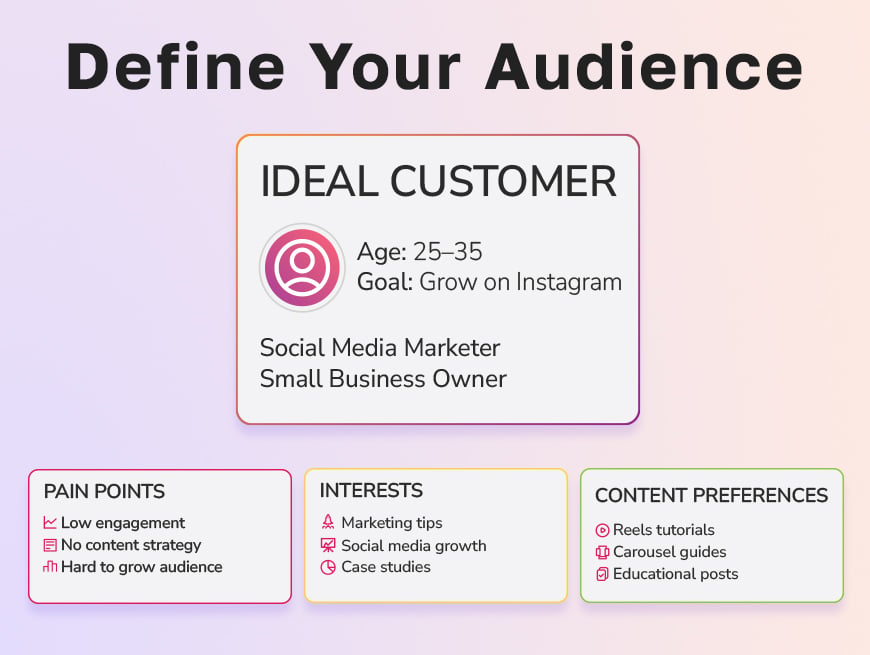
Up your follower count, and you’ll find success, right? Not quite. Remember that not every follower is a potential customer, and not every potential customer will want the same type of content. Don’t start planning your posts until you can be specific about who you want to reach. Consider these important questions:
- What problem does your ideal follower need solved?
- What kind of content would catch their eye while scrolling?
- What’s holding them back from clicking, messaging, or buying?
- What tone do they like to see: playful, polished, expert, or direct?
Now it’s time to see what is already working for you on Instagram. If you’ve already made some posts, look at what people are saying in the comments, what they are sending you in messages, which posts are doing well, and what your profile insights are telling you. Remember, you’re not trying to make posts that everyone will like. You are trying to make posts that the people who are most likely to care about what you are selling will like.
Learn From Competitors
A lot of brands go about competitor research the wrong way. They look at what content works for others and feel as if they have to do the same exact thing. It somewhat makes sense on paper, but usually doesn’t in reality. That’s because mimicking doesn’t make you stand out; it muddies the waters and flattens your brand voice.
Now, we’re not saying that you should ignore what your competitors are doing because you should definitely pay attention. But do it to learn from them, not to copy. Look at what type of content is working for them and then find gaps you can fill. When looking at your competitors, ask yourself these questions:
- Are they using Reels, educational carousels, testimonials, or Stories a lot?
- Which topics get people really engaged with lots of comments and shares?
- Are people asking questions in the comments that haven’t been answered well?
- Are there gaps in their messaging, branding, or customer education?
This is where using tools to research can be really helpful. Instead of jumping between tabs and taking notes, use tools to make life easier. You can see how often competitors post, how much engagement they get, see popular hashtags, and see what time they post. We’ll talk more about this a little later.
Craft a Compelling Profile
Another common mistake brands make when creating their Instagram profile is trying to do or say too much at once. The key to putting together a great profile is answering three important questions at a glance:
- Who do you help?
- What do you offer?
- Why should visitors care?
To accomplish this, follow these steps:
- Ensure your profile photo is recognizable. If you own a company, use your company logo. If you’re a personality, use a clear selfie without a lot of background distraction.
- Pick a handle that instantly identifies you and is easy to search. Don’t try to be clever here unless you’re an established brand with an existing following.
- Include specific, helpful info in your bio. Avoid vague claims that could belong to any account in your category.
Map Out Your Content Ideas
Once your Instagram profile is ready, content planning becomes much easier because you know what the page is supposed to do. Now it’s time to figure out how you’re going to achieve it. A practical content map usually includes a few repeatable buckets, such as:
- educational posts that answer common questions
- proof content like reviews, before-and-afters, or client wins
- behind-the-scenes updates that make the business feel human
- product or service explainers or tutorials
- conversion-oriented posts tied to product launches and special offers
This is also the time to consider and balance short-term relevance with long-term value. Creating timely posts can bring quick spikes in attention, but evergreen content often keeps attracting the right people long after publishing. A healthy mix of the two will give your account more range.
Track Performance & Optimize
Wouldn’t it be fabulous if you could figure out an Instagram marketing strategy and then let it do its thing? Unfortunately, no strategy stays good for long if you never review it. Thankfully, the most useful review habit is simple: Just look at your top and bottom performers every few weeks and ask why they behaved the way they did. What you want to look for are patterns you should continue following:
- Did certain hooks pull more saves?
- Did one content format consistently outperform the others?
- Were your strongest posts tied to a specific pain point?
Next, you need to look at the performance data for your Instagram account. Looking at the hard facts will help you make decisions based on evidence instead of just guessing. The useful metrics to look at are things like reach, engagement, follower growth, completion rate for Stories or Reels, and direct message activity.
Must-Have Tools for Effective IG Marketing
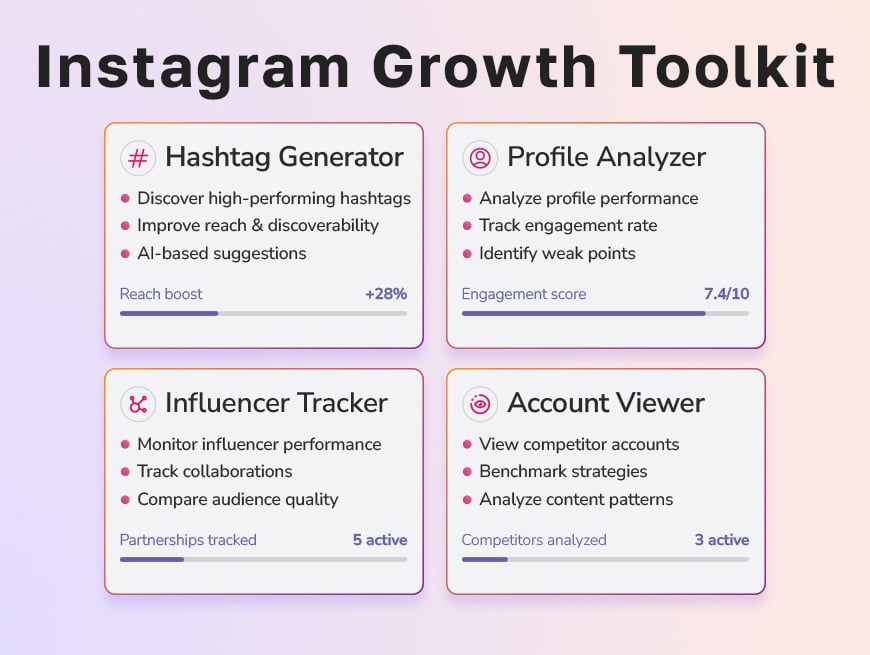
Even the best Instagram marketing techniques become hard to keep up with if every task takes too long. This is where the account analysis and tracking tools we mentioned earlier come into play. These tools can really help you by cutting down on research time, making it easier to make decisions and helping you find growth opportunities faster. Let’s take a look at tools you really need to have:
Hashtag Generator
If you’re still choosing hashtags by just thinking of the first words or phases that come to mind, you’re doing it all wrong. Guessing is one of the slowest and least reliable parts of getting content ready, so it’s time to work smarter, not harder.
A hashtag generator for Instagram is a wonderful tool because it can do a lot more than just give a list of popular tags. It can also help you build a list of hashtags that are tightly related to your keyword, topic, and language. You should use a hashtag generator when you’re planning an Instagram post or Reel. You can compare tags with more niche ones and build a list of favorite hashtags for the types of content you post regularly. Instagram hashtag generators are especially helpful when you want to make your content more discoverable without using overcrowded tags.
Profile Analyzer
If you want to understand what’s happening in your niche, an Instagram analytics tool is a great place to start. Inflact’s tool can analyze any public Instagram profile and provide metrics like followers, engagement rate, posting frequency, top hashtags, common caption words, audience interests, and top-performing posts. This data helps you see what patterns are driving attention so you know what to focus on for your content campaign.
Influencer Tracker
Working with influencers can be a smart Instagram marketing tactic that benefits your brand greatly, but it can also get a bit messy. You can’t just look at follower counts; you also need to consider if they fit your brand, if their audience is relevant, and if their engagement is real. Managing outreach and monitoring performance can be hard, especially when you have other things to handle.
A good influencer tracker helps you see which partnerships are working and which aren’t. Use one to track changes in follower count, engagement rate, and new posts. This way you can easily compare collaborators, watch campaign momentum, and more.
Account Viewer
Try your hand at manually doing competitor research, and you’ll quickly find that it can be tedious and extremely time-consuming. A better approach is to use an account viewer. This type of tool gives you a quick and easy way to inspect a public profile before you commit time to a deeper analysis.
Inflact’s Instagram Profile viewer lets you take a fast peek at an account’s public posting patterns, visible activity, and content style so you can decide in just minutes whether an account is worth studying further. If you like what you can see, you can add the account to your watchlist. If you don’t, just move on to the next one. Additionally, you can use our Instagram Story Viewer and browse any public Stories without logging in, allowing you to see what users share beyond their regular posts.
Profile Downloader
An Instagram profile downloader is another awesome tool that you can use downloading reference materials. Save posts, images, reels, and other content for mood boards, creative review, and even competitor tracking.
We know what you’re thinking: Didn’t we say earlier that competitor research should never be about simply trying to copy another brand? This is absolutely true, but that doesn’t mean you can’t use what competitors are doing to create a reference library for campaign planning or creative audits.
When you see something you like or that intrigues you, use the profile downloader (also available as a convenient Chrome extension) to save it for future reference. Inflact’s downloader has the added benefit of providing download-related profile data, so you can research and archive in one step.
Advanced Instagram Marketing Tactics & Strategies
Once your Instagram strategy’s foundation is solid, you can move past routine posting and start employing more deliberate growth levers.
Quick Tactics
Let’s start with a few simple but effective Instagram marketing tips:
- Always start off strong. Whether it’s the first line of a caption, the first slide of a carousel, or the first second of a Reel, you have to make sure that first look is doing serious heavy lifting. Giving people a reason to stop is the first step to starting them on their conversion journey.
- Turn one idea into several assets. Repurposing Instagram content can protect your time without making your feed feel repetitive. For example, from a strong reel, you can pull a Story, a caption, a quote graphic, and a FAQ answer.
- Use Stories to elicit responses. Don’t post with the goal of simply broadcasting. Instead, use polls, Q&As, and replies to help make your followers feel closer to your brand. What they have to say can help reveal what content you should make next.
- Treat engagement like market research. When viewers send you DMs or leave comments, really pay attention to what is being said. Questions, objections, and repeated sentiments from real people are some of the best content prompts you’ll ever get.
Advanced Strategies
Once you’ve got the basics down, Instagram marketing is really about connecting the dots. A single strong post can help, sure, but it usually won’t carry the whole strategy. What works better is creating content that leads people somewhere, from noticing your brand, to trusting it, to finally taking action. One way to do that is by planning posts in groups around the same topic. Don't post something today, and then something totally different tomorrow. Start with a problem your audience knows well. Then explain how to solve it.
After that you need to show your audience why they should trust you and your brand. This could be a customer review, a story about a customer, a result you've achieved, or a quick example of what you can do. Once you've done all these things it will feel more natural to post about something you're trying to sell. It also helps to post things each week that people expect from you and your company. This could be a tip, a short demo of one of your products, or a list of mistakes to avoid. These types of posts give your followers a reason to come back to your page. Over time people will remember you. Plus, they might share your brand with others they know.
How to Know If Your Instagram Strategy Works
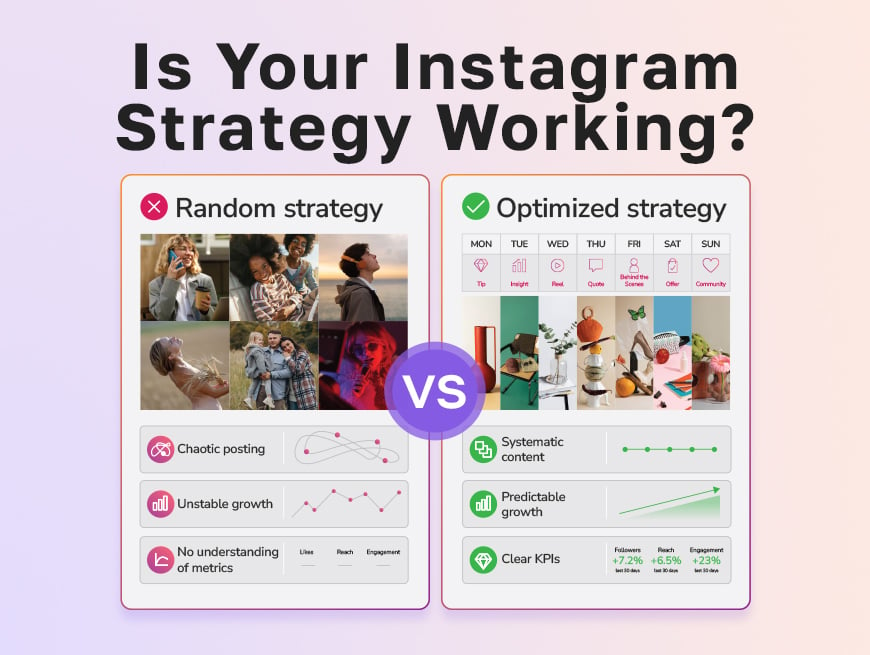
Simply put: You’ll know your Instagram strategy is working when the right numbers are moving for the right reasons. This means not only are you seeing attention, you’re seeing the kind of attention that matches what you want to achieve.
Like we mentioned before, if you want brand awareness, your profile visits should trend up. If you want leads, look for an increase in link clicks and inquiries. Don’t focus on a single metric unless there is a good reason to. Everyone loves the idea of having lots of Instagram followers, but if you’re trying to make sales, it makes no sense to have thousands of followers who have no plans to make a single purchase.
Don’t forget that you also need to look at the big picture; take off the blinders and take a step back. When measuring your Instagram performance, look for patterns over time rather than focusing too much on how an individual post did.
Think of it like this: Maybe one of your Instagram posts flops due to bad timing. It happens, and it’s not necessarily a sign of a bad strategy. However, if you have five low-performing posts relating to the same topic, it may be time to rework your angle.
A clear sign that your strategy is working is when your content becomes easier to make because your audience response is easier to predict. This is truly an exciting time because your data stops feeling like a numbers game and starts feeling like an instinct… things stop feeling random and start feeling repeatable.
Turn Your Instagram Presence Into a Real Growth Channel
If you want your Instagram marketing strategy to pay off, you have to post with clarity and intent. Figure out who you want to reach and what kind of content earns that attention, and you’ll be well on your way to enjoying the performance you hope for.
FAQs
What tasks can Instagram marketing automation handle for you?
It’s best to use Instagram automation to handle repetitive work, especially around planning and consistency. Consider setting up systems to help with things like research, post scheduling, reporting, comment moderation, and performance tracking.
Just keep in mind that automation is ideal for routine tasks, the things that happen on the backend to ensure everything runs smoothly. Don’t use it for anything relating to your brand’s personality. Otherwise, your audience may not feel as if there’s a real person behind your Instagram business account.
What are the benefits of using Instagram Checkout for your business?
The biggest benefit of Instagram Checkout is that it reduces friction to allow for more conversions. It offers visitors the opportunity to discover a product and complete their purchase without having to leave the app, which means there are fewer chances for distraction or dropoff.
How can brand mentions and interactive webinars grow your Instagram audience?
Brand mentions are helpful because they introduce you to adjacent audiences through trust that already exists. When a brand mention comes from a respected partner, creator, or customer, it carries weight.
Webinars are helpful in a different way. This type of content deepens attention by allowing for meaningful interaction. Instagram Live allows your followers to watch in real time and comment through the built-in chat, making it useful for Q&As, launches, and demonstrations.
Where to find fresh content ideas for Instagram?
You really don’t have to go too far for fresh ideas, and we will continue to reiterate: Always take a deliberate approach to creating content. Rather than guessing what your audience wants to see, give them exactly what they want. How do you know what they want? Check your comments and DMs. Your audience is literally telling you what they need; it doesn’t get much more direct than that.
-
What Instagram Marketing Really Means for Your Business
-
Building a Winning Instagram Marketing Strategy
-
Define Your Instagram Success Metrics
-
Discover Your Ideal Audience
-
Learn From Competitors
-
Craft a Compelling Profile
-
Map Out Your Content Ideas
-
Track Performance & Optimize
-
Must-Have Tools for Effective IG Marketing
-
Hashtag Generator
-
Profile Analyzer
-
Influencer Tracker
-
Account Viewer
-
Profile Downloader
-
Advanced Instagram Marketing Tactics & Strategies
-
Quick Tactics
-
Advanced Strategies
-
How to Know If Your Instagram Strategy Works
-
Turn Your Instagram Presence Into a Real Growth Channel
-
FAQs
-
What tasks can Instagram marketing automation handle for you?
-
What are the benefits of using Instagram Checkout for your business?
-
How can brand mentions and interactive webinars grow your Instagram audience?
-
Where to find fresh content ideas for Instagram?
Related Articles





Significant benefits